
Table of Contents
- Executive Summary: Navigating China’s Solution-Dyed Polyester Landscape
- Technical Deep Dive: The Science of Solution Dyeing
- China’s Manufacturing Ecosystem: Infrastructure and Capability Analysis
- Quality Assessment Framework: Critical Parameters and Testing Protocols
- Comparative Market Analysis: China vs. Global Production Centers
- Application-Specific Quality Requirements
- Supplier Qualification Protocol: Due Diligence Checklist
- Advanced Quality Control Systems in Chinese Mills
- Total Cost Analysis: Beyond Unit Price
- Innovation and Sustainability: China’s Roadmap
- Risk Mitigation Strategies for International Buyers
- Strategic Sourcing Recommendations
- Frequently Asked Questions (FAQ)
1. Executive Summary
The global textile industry’s transition to solution-dyed polyester represents one of the most significant material innovations of the past decade. As the world’s largest producer, How Good is the Quality of Chinese Bulk Solution-Dyed Polyester Filament Yarn? A Comprehensive Guide for Global Buyers China’s capabilities in this sector have evolved from basic commodity manufacturing to sophisticated, high-quality production. This comprehensive analysis reveals that top Chinese manufacturers now operate at quality levels comparable to global leaders, with particular strengths in color consistency (ΔE 0.5-1.5), mechanical properties (tenacity 3.8-4.5 g/den), and production scalability. However, the market exhibits a three-tier structure where quality correlates directly with technological sophistication and price positioning. For international buyers, success requires understanding this stratification, implementing rigorous verification protocols, and establishing strategic partnerships with technically advanced suppliers who can provide application-specific solutions and reliable supply chain continuity.
2. Technical Deep Dive: The Science of Solution Dyeing
Solution dyeing (also called dope dyeing or mass coloration) represents a fundamentally different approach from conventional post-production dyeing. The process involves:
Polymer Stage Integration: Pigments or dyes are introduced at the polymer melt stage before extrusion, typically via masterbatch systems or direct pigment injection. This ensures molecular-level color distribution throughout the polymer matrix.
Advantages Over Conventional Dyeing:
- Color Permanence: Colors are locked within the fiber structure, providing exceptional resistance to fading from UV exposure (600+ hours xenon arc testing), chlorine, perspiration, and repeated washing.
- Resource Efficiency: Eliminates the water-intensive dye bath process, reducing water consumption by 60-80% and energy use by 30-50%.
- Chemical Reduction: Removes the need for auxiliary chemicals, salts, and fixatives used in conventional dyeing.
- Production Speed: The coloring process is integrated into fiber production, shortening lead times by 4-6 weeks compared to piece-dyed fabrics.
Technical Limitations and Solutions:
- Color Matching Challenges: Initial color development requires precise formulation. Advanced Chinese mills now employ computerized color matching systems with spectrophotometric feedback loops that achieve ΔE < 1.0 for production batches.
- Minimum Order Quantities: While higher than stock colors, MOQs have decreased significantly. Leading mills offer 500-1,000 kg MOQs for custom colors, compared to 3-5 tons a decade ago.
- Color Range Limitations: Certain fluorescent and extremely bright shades remain challenging. However, China’s pigment industry has developed specialized dispersions that have expanded the achievable color gamut by approximately 40% since 2018.
3. China’s Manufacturing Ecosystem: Infrastructure and Capability Analysis
China’s dominance in solution-dyed polyester stems from a uniquely integrated supply chain:
Vertical Integration Patterns:
- Level 1: Fully integrated complexes (e.g., Rongsheng Petrochemical, Hengli Group) that control production from crude oil to PTA/MEG, polymerization, and spinning.
- Level 2: Specialized spinning mills with captive polymerization but external raw material sourcing.
- Level 3: Independent spinning mills purchasing pre-colored polymer chips.
Regional Specialization:
- Zhejiang Province: Focus on fine denier (10D-75D) yarns for apparel and technical textiles. Notable for innovation in functional additives.
- Jiangsu Province: Dominates heavy denier (300D-3000D) production for industrial applications, carpets, and upholstery.
- Fujian Province: Specializes in recycled (rPET) solution-dyed yarns, leveraging strong regional recycling infrastructure.
Technological Sophistication:
Modern Chinese mills have made substantial investments in:
- Continuous Polymerization (CP) Systems: 90% of new capacity since 2020 utilizes CP technology, ensuring superior polymer homogeneity.
- Automated Pigment Dispersion: Computer-controlled dosing systems with real-time viscosity monitoring.
- Smart Manufacturing: IoT-enabled production lines with less than 2% coefficient of variation in denier throughout production runs.
4. Quality Assessment Framework: Critical Parameters and Testing Protocols
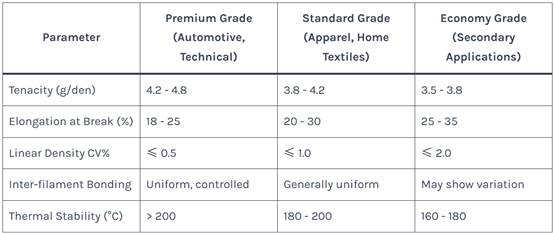
A comprehensive quality assessment requires evaluation across five domains:
- Mechanical Properties
Table 1: Mechanical Specifications by Application Tier
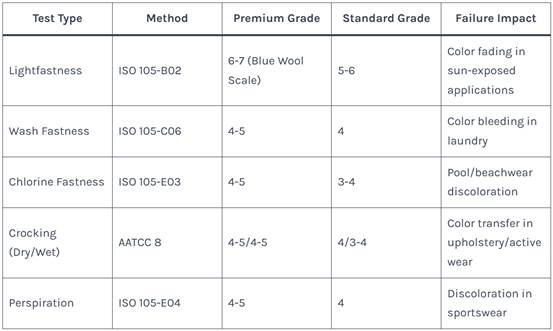
- Color Performance Metrics
Table 2: Color Fastness Standards
C. Consistency and Uniformity
- Color Consistency (ΔE): Premium mills achieve ΔE < 1.0 between batches; standard mills < 2.0.
- Denier Uniformity: Measured via Uster UCV%, with premium lines achieving < 0.8%.
- Package-to-Package Variation: Controlled through automated doffing systems and centralized tension control.
D. Application-Specific Testing
- Automotive: Fogging resistance (< 2 mg), abrasion resistance (Martindale > 40,000 cycles)
- Outdoor: Hydrolysis resistance (95°C/95% RH for 500+ hours)
- Home Textiles: Pilling resistance (ICI pilling box 4-5)
5. Comparative Market Analysis: China vs. Global Production Centers
Table 3: Global Competitive Analysis
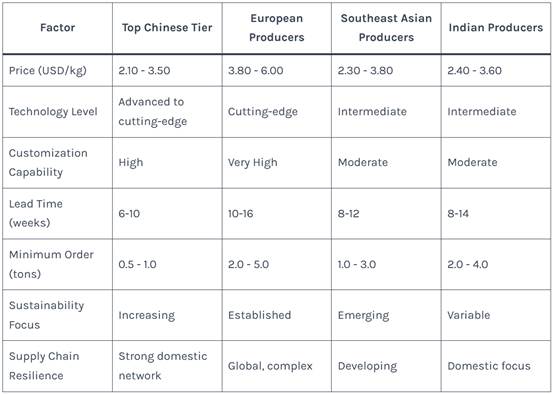
Critical Insight: China’s advantage extends beyond price to include supply chain completeness, with 85% of raw materials and equipment sourced domestically, reducing external dependency risks.
6. Application-Specific Quality Requirements
Automotive Interiors:
- Color Matching: ΔE < 0.5 under multiple light sources (D65, TL84, A)
- Fogging: < 2 mg (DIN 75201)
- Abrasion: > 40,000 cycles (Martindale)
- Lightfastness: > 600 hours xenon arc without appreciable fading
- Leading Chinese Suppliers: Zhejiang Materials, Jiangsu Guowang
Outdoor and Technical Textiles:
- UV Resistance: > 800 hours xenon arc with < 20% strength loss
- Hydrolysis Resistance: Maintains 80% strength after 500 hours at 95°C/95% RH
- Mildew Resistance: ASTM G21, Grade 0 after 28 days
- Leading Chinese Suppliers: Tongkun Group, Zhejiang Hengyi
Apparel and Sportswear:
- Moisture Management: Wicking height > 120 mm in 30 minutes
- Stretch Recovery: > 90% after 100 stretch cycles
- Chlorine Resistance: Maintains color after 50 ppm chlorine exposure
- Leading Chinese Suppliers: Shenghong Group, Xin Feng Ming Group
7. Supplier Qualification Protocol: Due Diligence Checklist
Phase 1: Preliminary Screening
- Annual capacity > 50,000 tons
- Vertical integration (polymerization capability)
- ISO 9001:2015 certification
- OEKO-TEX Standard 100 certification
- Established export history (5+ years)
Phase 2: Technical Capability Assessment
- In-house R&D laboratory
- Spectrophotometric color matching system
- Uster testing equipment
- Pilot production line for development
- Traceability system (batch to raw material)
Phase 3: Production Audit
- Polymer homogeneity control systems
- Automated pigment dosing accuracy (±0.1%)
- Clean room conditions for fine denier spinning
- Packaging integrity and contamination prevention
- Statistical process control implementation
Phase 4: Sample Validation
- Production-equivalent sample testing
- Third-party laboratory verification
- Pilot production run evaluation
- Color continuity across multiple production lots
8. Advanced Quality Control Systems in Chinese Mills
Digital Integration:
- Real-time Monitoring: Sensors track 200+ parameters throughout production
- Predictive Analytics: AI algorithms forecast maintenance needs and quality deviations
- Blockchain Traceability: Selected mills now offer blockchain-based supply chain transparency
Laboratory Capabilities:
- Color Science Laboratories: Equipped with spectrophotometers, goniophotometers, and spectral analysis software
- Physical Testing: Automated tensile testers, evenness testers, and abrasion resistance equipment
- Chemical Analysis: FTIR, DSC, and TGA for polymer characterization
Continuous Improvement:
- Six Sigma Implementation: Top mills operate at 4.0+ sigma levels
- Lean Manufacturing: Waste reduction initiatives achieving 95%+ material utilization
- Customer Feedback Integration: Closed-loop systems incorporating client performance data
9. Total Cost Analysis: Beyond Unit Price
Direct Costs:
- Raw material cost advantage: 15-25% lower than global average
- Labor productivity: 30% higher than Southeast Asian counterparts
- Energy costs: Competitive industrial electricity rates
Indirect Costs:
- Logistics: Well-developed port infrastructure reduces shipping costs
- Inventory: Shorter lead times enable lower safety stock
- Quality failure: Higher initial quality reduces downstream rejection rates
Hidden Value Drivers:
- Technical Support: Leading mills provide application engineering support
- Co-development: Joint product development without NRE charges for volume commitments
- Supply Chain Financing: Extended payment terms available through Chinese banking partners
10. Innovation and Sustainability: China’s Roadmap
Technology Development:
- Nanoparticle Integration: TiO2 and ZnO nanoparticles for enhanced UV protection
- Phase Change Materials: Microencapsulated PCMs for thermal regulation
- Conductive Fibers: Carbon nanotube integration for smart textile applications
- Biodegradable Additives: Accelerating decomposition in landfill conditions
Sustainability Initiatives:
- Carbon Neutrality Goals: Major producers targeting carbon neutrality by 2030
- Circular Economy: rPET production reaching 30% of total output by 2025
- Water Stewardship: Implementing zero liquid discharge systems
- Green Certifications: Increasing adoption of GRS, RCS, and Higg Index reporting
Digital Transformation:
- Smart Factories: 5G-enabled production facilities with < 1% downtime
- Digital Twins: Virtual replica systems for process optimization
- E-commerce Platforms: B2B platforms with real-time inventory and sampling
11. Risk Mitigation Strategies for International Buyers
Quality Risks:
- Implement third-party pre-shipment inspection (SGS, Bureau Veritas)
- Establish clear AQL (Acceptable Quality Level) in contracts
- Require retention samples from each production lot
Supply Chain Risks:
- Dual sourcing from different Chinese regions
- Maintain buffer stock for critical products
- Regular supplier financial health monitoring
Commercial Risks:
- Use letters of credit with quality clauses
- Verify export licenses and compliance documentation
- Include penalty clauses for quality failures
12. Strategic Sourcing Recommendations
For Large Volume Buyers (100+ tons annually):
- Establish direct relationships with Tier 1 integrated producers
- Consider equity partnerships or long-term supply agreements
- Implement vendor-managed inventory systems
For Medium Volume Buyers (20-100 tons annually):
- Work through specialized trading companies with technical expertise
- Focus on regional specialists rather than generalists
- Participate in factory group audits
For Small Volume Buyers (< 20 tons annually):
- Utilize B2B platforms with verified supplier programs
- Combine orders with complementary businesses
- Focus on stock color programs to reduce MOQs
Best Practices for All Buyers:
- Conduct annual supplier audits, including unannounced visits
- Develop joint quality standards and testing protocols
- Invest in relationship building through regular technical exchanges
- Stay informed about regulatory changes affecting imports
- Diversify geographically within China to mitigate regional disruptions
13. Frequently Asked Questions (FAQ)
Q1: How has Chinese solution-dyed polyester quality evolved in the past 5 years?
A: Significant advancements have occurred: ΔE consistency improved from 2.0-3.0 to 0.5-1.5; tenacity increased by 15%; lightfastness standards now routinely exceed 500 hours xenon arc; and automated quality control has reduced defect rates from 3% to under 0.5%.
Q2: What are the actual production lead times including color development?
A: For stock colors: 4-6 weeks. Custom color development adds 2-3 weeks for formulation, lab dip approval, and pilot production. Total timeline: 6-9 weeks for established relationships, 8-12 weeks for new partnerships.
Q3: How do Chinese solution-dyed yarns perform in rigorous certifications like bluesign®?
A: An increasing number of Chinese mills (approximately 15 as of 2024) hold bluesign® certification. Their yarns meet stringent chemical requirements, with comprehensive RSL (Restricted Substances List) compliance testing available.
Q4: What is the real capacity utilization rate in Chinese mills?
A: Premium tier mills operate at 85-95% utilization, mid-tier at 70-85%, and lower-tier at 60-75%. This affects both responsiveness and quality consistency during peak demand periods.
Q5: How transparent are Chinese suppliers about their supply chain?
A: Transparency varies significantly. Top-tier suppliers provide full chemical disclosure, carbon footprint data, and supply chain mapping. Blockchain initiatives are increasing transparency, particularly for recycled content verification.
Q6: What are the payment term norms for international buyers?
A: Standard terms: 30% deposit, 70% against bill of lading copies. Established relationships may secure 30-day payment terms after shipment. Letters of credit remain common for new relationships.
Q7: How significant are MOQ reductions for custom colors recently?
A: Significant reduction: From 3-5 tons five years ago to 500-1,000 kg currently for many premium mills, enabled by improved pigment dispersion technology and flexible production scheduling.
Q8: What technical support can buyers expect from Chinese mills?
A: Leading mills provide: application engineering support, troubleshooting assistance, joint development programs, fabric testing guidance, and regular technical updates on product improvements.
Q9: How is the recycled content verified in Chinese rPET solution-dyed yarns?
A: Verification requires: GRS certification with transaction certificates, batch-specific documentation, supplier audits, and increasingly, isotope testing for post-consumer content verification.
Q10: What are the most common quality disputes and their resolution mechanisms?
A: Common disputes: color matching (30%), mechanical property variations (25%), packaging/shipping damage (20%), documentation errors (15%). Resolution typically involves: retention sample testing, third-party arbitration, or contractual penalty application based on mutually agreed specifications.