
So you’re considering a career in project management? Well that’s a great decision – project management is a field that’s booming and is going to need millions of new professionals world wide. But let’s be honest, starting out can feel like trying to climb a mountain. Where do you even start? For a lot of people, the answer lies in getting a PMI certification. And if you’re new to the field, getting the Certified Associate in Project Management, or CAPM, is usually the first big step.
Getting that credential is a big statement, it shows employers you ‘get’ the language and the processes of project management. But let’s not beat around the bush: the exam can be a real challenge. Thats where a smart tool like a CAPM practice test can come to the rescue. But to be honest this guide is about more than just telling you what you need to study, it’s about giving you some actual strategies for studying that work. We’ll take it from the ground up – from understanding why a PMI certification is worth it all the way through to building a study plan that lets practice exams do the heavy lifting so you can pass with flying colours and take your career to the next level.
Understanding PMI Certification
What is PMI Certification?
The Project Management Institute (PMI) is the undisputed global leader in this field and you’d be lucky to have them as your benchmark. A PMI certification is a serious recognition that you’ve got the knowledge, skills and experience that PMI says are vital to a project professional. It’s the stamp of approval that comes with being part of a global community of project pros, one that’s respected across industries and borders.
It’s not just a paperweight to stick on your resume though earning a PMP (Project Management Professional) will actually increase your salary by a whopping 17% that’s what holders of the PMP are seeing. Although the CAPM is a good starting point, it lays the foundation in trusted knowledge that will stand you in good stead.
Different Types of PMI Certifications
PMI have an armoury of credentials, each one tailored for a specific stage of your career journey. So whether you are starting out or looking to move up the ladder, there is a PMI certification to suit:
- No experience needed to get started – The Certified Associate in Project Management (CAPM) is perfect for students, or team members wanting to get involved in projects.
- For those with some experience under their belt, the Project Management Professional (PMP) – the flagship certification – is the one to aim for. There are also specialist credentials such as the PMI Agile Certified Practitioner (PMI-ACP) or the PMI Risk Management Professional (PMI-RMP) that will help you stand out.
- Managing lots of projects (Programs) or a portfolio of projects and programs? Then take a look at the more advanced certifications on offer.
The best bit is that you can start with one PMI certification like the CAPM and build your way up – the structure is there to help you along.
Benefits of Getting PMI Certified
So why bother getting certified? The reasons are clear:
- Employers love seeing a PMI certification on your resume – it shows your commitment to the job and some solid knowledge to boot. You’ll stick out from the competition in a busy job market.
- Preparing for the exam forces you to get your head round a structured & proven way of project management – it’s not just theory, it’s a practical framework you can use in the real world.
- Global recognition and community is also a big draw, 1.7 million certification holders strong, with plenty of networking and learning opportunities at your fingertips.
The Role of CAPM in Project Management
Definition of CAPM (Certified Associate in Project Management)
The CAPM is a entry level project management certification that’s administered by the Project Management Institute (PMI). At its core, it shows you have a solid grasp on the basics of project management – the terminology, the processes, the whole shebang. According to PMI’s own standards (specifically the PMBOK Guide), it shows you can talk the talk when it comes to running a project.
Target Audience for CAPM Certification
The CAPM is right up the alley for:
- Anyone looking to become a project manager: you’ve got little or no project management experience but you’re eager to start your career in the field.
- Team members & recent graduates: you’re already contributing to projects but you want to learn more about the processes involved – and use that knowledge to get promoted into a leadership role.
- People looking to switch careers: you’re moving into a project-based role from another field and you need to get up to speed quick so you can build some credibility.
Key Skills and Knowledge Areas Covered
The CAPM is a pretty broad exam – it’s based on the PMBOK Guide and covers 4 main areas:
- Project Management Fundamentals and Core Concepts (36% of the exam) – a broad overview of life cycles, roles, planning, and dealing with problems.
- Predictive, Plan-Based Methodologies (17%) – traditional / waterfall style approaches to managing projects.
- Agile Frameworks/Methodologies (20%) – adaptive approaches like Scrum & Kanban.
- Business Analysis Frameworks (27%) – understanding what stakeholders need, gathering requirements, and creating product roadmaps.
This mix shows that real world project management is about combining different approaches – and the CAPM shows you’re ready to work with that.
Why Practice Tests Are Your Non-Negotiable Secret Weapon
You can read the guidebooks cover to cover – but unless you test out your knowledge under exam like conditions, you’re basically going in with your eyes shut. A CAPM practice test is way more than just a routine quiz – it’s really a super useful tool both for sorting out what you know and for getting a better grasp of what you don’t.
How a Practice Test Can Actually Help You
Reading is a pretty passive thing to do but testing requires effort and thought. Practice exams do all of the following:
- Show you how to apply the concepts, not just recite them – because on the real exam you’ll be asked to work with what you know and come up with the right answer in a tricky situation.
- Uncover gaps in your knowledge that you might not have even noticed – it’s easy to think you get something but a multiple choice question with four almost identical options will quickly show up any lack of understanding.
- Cover everything with a reputable practice test you make sure you’re studying all the right areas, not just the bits that interest you the most.
Finding and Choosing Effective CAPM Practice Tests
Not all practice tests are created equal. Using rubbish questions can lead you to waste your time studying the wrong things. Here is what to look for in a test that is actually going to help you.
Criteria for Choosing Quality Practice Tests
Does it follow the current Exam Content Outline (ECO)?
The PMI puts out a detailed ECO for the CAPM. Any halfway decent test bank will be specifically based on the latest version. With the exam changing so much in 2023, do yourself a favour and avoid anything that’s out of date.
Does it have a good mix of question formats?
Real exams use multiple choice, drag and drop, and even video questions. Your practice tests should have a similar variety.
Are the answers explained in detail?
Getting an answer wrong is basically useless if you don’t get to understand why its wrong. The best resources give you a thorough explanation of each answer, and even reference the PMBOK Guide.
Does it give you any useful performance analytics?
Look for tests that give you a breakdown of your score by domain (e.g., Agile, Business Analysis). This makes it easy to identify where you need to put extra effort in.
Recommended Sources and a Word on Structured Study
You can find reliable questions on:
- PMI Authorized Training Partners (ATPs): These guys have a deal with PMI to create study materials that meet their standards.
- Reputable online platforms: Some of the big test prep companies have invested in creating a big bank of questions that are actually good.
- The Official PMI Resources: PMI Certification itself does have some sample questions and an exam simulator for the PMP, which shows you what quality looks like.
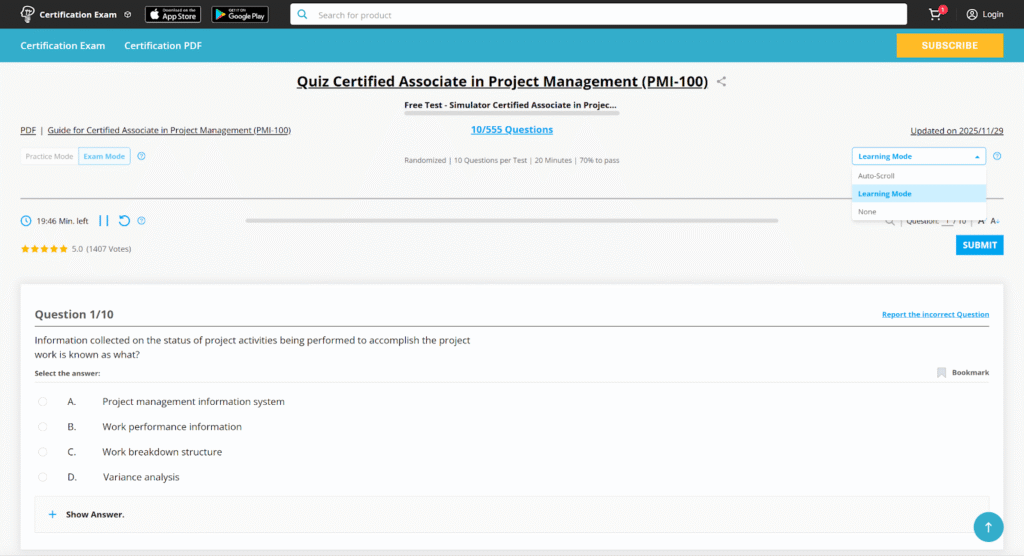
And if you don’t want to waste time sifting through free resources, some people find it really helpful to stick with a dedicated platform like Certification-Exam which specifically follows the test environment and content outline.
A Strategic Plan for Using CAPM Practice Tests
Don’t go around taking tests without a plan – think about how you can actually incorporate them into a regular study routine.
Creating a Study Schedule with Practice Tests
A pretty solid study plan for most people starts out stretching for about 6-8 weeks. Here’s how it really works in the real-world:
- First three weeks, focus on getting the basics down & taking quick little quizzes. Go subject by subject, studying one domain at a time. Every time you finish a chapter or section, give yourself a mini-test, 10-20 questions on that specific topic.
- Next couple of weeks, get out the big guns – full-length practice exams. Schedule your first 150 questions, 3 hours CAPM practice test to mirror the real deal- no phone, no snack breaks. This is your starting point.
- By week six, you’ll be doing targeted review. Use the results from your practice exam to see where you went wrong. Did you suck at Predictive Methodologies? Go back and relearn that, then take another quiz to see how you’re doing.
- Last couple of weeks (final stretch) do final mock exams and review. Take 2-3 more full-length exams, and the goal is to consistently kick it above 80%+ on practice tests and work on those timing issues.
Getting the Most Out of Your Results
This is the really important bit. After every single practice test:
- Go back over EVERY Question: Don’t just wonder why you got the ones you got wrong – take another look at the ones you made an educated guess on or struggled with.
- Categorize Your Mistakes: Was it a case of not knowing something? Misreading the question? Messing up a formula (like Earned Value Management)?
- Write Down What You Need to Work On: Take down the specific areas you messed up. Then, turn that list into a study guide for yourself to use in the last week.
Common Pitfalls to Avoid in Your Preparation
Knowing what NOT to do is half the battle
Over-relying on Practice Tests Rather Than Putting in Real Study Time
Practice tests are there to check your knowledge and skills, not to replace actual learning. If you just regurgitate question and answer sets from a CAPM practice test without ever really getting to grips with the underlying principles, you’ll struggle to cope when the real exam comes along. Use tests to make sure you’ve got the knowledge in the first place from guides and courses.
Taking Practice Tests without Keeping an Eye on the Clock
If you take a practice test with a coffee break, then binge on the next bit of cake while giving the room a quick tidy , you’re just kidding yourself that you’re training for the real pressure of the exam. Get into the habit of doing timed practice tests so you can build up the mental toughness you’ll need to keep going when it really counts.
Failing to Get to the Bottom of Your Mistakes on a Practice Test
Skipping the bit where you review your mistakes makes the practice test pretty much pointless. You only learn when you dig in to figure out where you went wrong and why the other option was actually the right one. That way you turn a mistake into a valuable lesson, rather than just a failure.
Additional Resources for a Well-Rounded CAPM Prep
Practice tests are a crucial part , but they really come into their own when used alongside other study resources
Recommended Books and Study Guides
- The PMBOK Guide (7th Edition): It’s the one that sets the tone for everything else – PMI members get the digital copy chucked in as a bonus
- CAPM Exam Prep Manuals: If you’re looking for something a bit more detailed in your study materials, books from the likes of Joseph Phillips, or maybe Peter Landini are pretty well liked among candidates for breaking down all the information into manageable chunks
Online Courses, Forums and all that other Good Stuff
- Formal Courses: You need one of these 23 hours courses to even get a shot at the exam in the first place – Providers like Udemy have got PMI approved courses that will get you that time in and are even chucked in with video lessons
- Study Groups and Online Forums: Communities like the r/CAPM sub on Reddit are a godsend for getting the moral support and a few tips and tricks from others who are going through the same stuff as you.
Conclusion: Taking Action on Your PMI Certification Path
Getting a PMI cert, starting with the CAPM, is a very smart investment in your career and quite frankly it will pay off big time. It proves you’ve got the skills, gets your name on a heap of potential employers radars, and gives you a clear roadmap to success.
First, get your hands on the official CAPM guide from PMI Certification, make a rough study schedule and book a date for the exam. Then take the plunge & do that first practice test to see just how much work you’ve got ahead of you and then start getting your head down.
Your career in project management is waiting in the wings, and a PMI cert is your ticket to get on that bus. So what are you waiting for? Get cracking now.